Sharpe Ratio: A Key Metric for Evaluating Risk-Adjusted Returns in Cryptocurrencies
What is the Sharpe Ratio?
The Sharpe ratio is a financial metric used to evaluate an investment’s risk-adjusted return. It helps investors understand how much return they are receiving for the risk taken. The Sharpe ratio is calculated by dividing the difference between an investment’s return and the risk-free rate by the investment’s standard deviation (a measure of risk or volatility). A higher Sharpe ratio indicates a better risk-adjusted return.
Sharpe Ratio in the Crypto Market
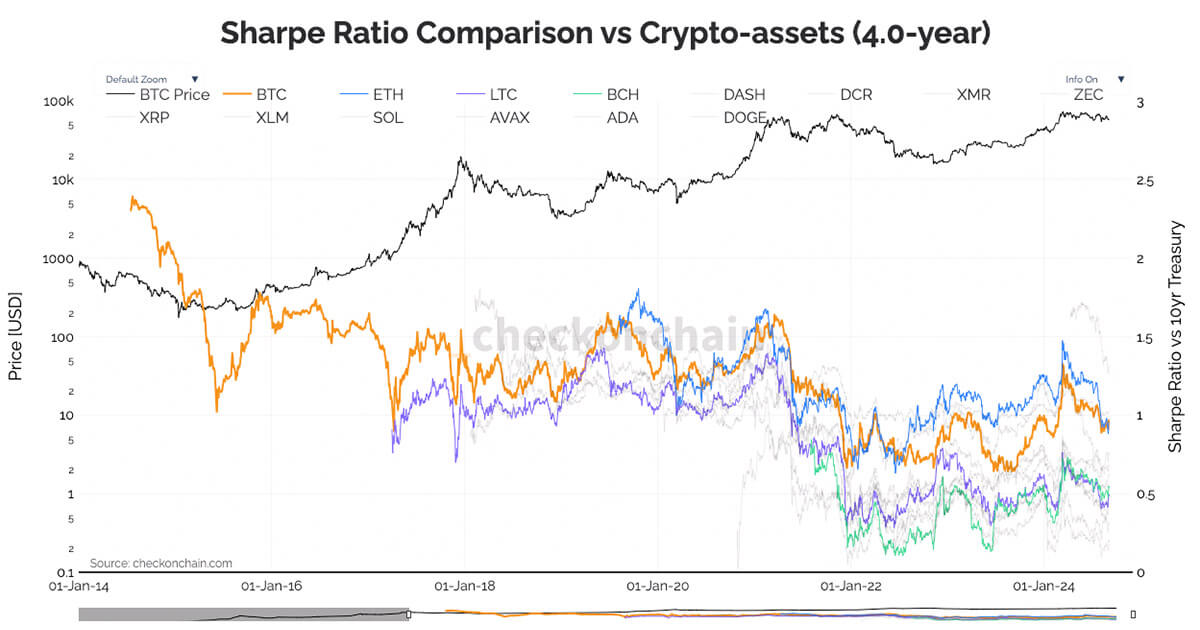
In the crypto market, the Sharpe ratio offers valuable insights. According to checkonchain.com, Bitcoin (BTC) currently has a Sharpe ratio of 0.97 on a 4-year rolling basis, indicating a strong performance relative to its risk. Notably, BTC’s Sharpe ratio has recently surpassed Ethereum’s (ETH) for the first time since July 2022, with ETH now at 0.95.
Sharpe Ratio Comparison among Major Digital Assets
Among major digital assets, only Solana (1.32) and Dogecoin (1.00) boast higher Sharpe ratios than Bitcoin. Other significant coins, such as XRP and ADA, have decreased Sharpe ratios, reflecting weaker risk-adjusted returns. Forks of Bitcoin, like Bitcoin Cash and Litecoin, have even lower Sharpe ratios of 0.54 and 0.46, respectively.
Historical Performance of Bitcoin’s Sharpe Ratio
Historically, BTC’s Sharpe ratio was much higher, reaching 2.33 in 2014. However, it has been on a downward trend since then, indicating increasing risk or diminishing returns over time.
Conclusion
The Sharpe ratio is a valuable tool for evaluating the risk-adjusted returns of cryptocurrencies. In the current market, Bitcoin’s Sharpe ratio of 0.97 suggests a strong performance relative to its risk. However, investors should be aware that historical trends may not necessarily predict future performance, and it is essential to carefully consider the risks and rewards associated with any investment decision.
FAQs
- What is the Sharpe ratio? The Sharpe ratio is a financial metric used to evaluate an investment’s risk-adjusted return.
- How is the Sharpe ratio calculated? The Sharpe ratio is calculated by dividing the difference between an investment’s return and the risk-free rate by the investment’s standard deviation (a measure of risk or volatility).
- What does a higher Sharpe ratio indicate? A higher Sharpe ratio indicates a better risk-adjusted return.
- How does the Sharpe ratio compare among major digital assets? Among major digital assets, only Solana (1.32) and Dogecoin (1.00) boast higher Sharpe ratios than Bitcoin. Other significant coins, such as XRP and ADA, have decreased Sharpe ratios, reflecting weaker risk-adjusted returns.
- What does the historical trend of Bitcoin’s Sharpe ratio indicate? The historical trend of Bitcoin’s Sharpe ratio indicates increasing risk or diminishing returns over time.