Rewrite the
TL;DR
The Solana Foundation Delegation Program was introduced in November 2020 to address early Solana validation bootstrapping through performance-based stake delegation.
As network participation and third-party delegation expanded, the program has evolved to reduce Foundation reliance and support economically independent validators vs. total validators.
Highlights
-
The program’s stake share declined as external delegation increased. Non-SFDP stake grew ~230% since the program’s launch in November 2020
-
Validators with at least 50k SOL outside SFDP delegations increased by 121% since the launch of the revised SFDP delegation strategy in April 2024
-
In 2024 and 2025, SFDP took a more concerted effort to reduce reliance on Foundation stake as validator economics and external delegation matured
-
The result is an economically independent validator set that supports decentralization and maintains robust network performance
Introduction
On November 11, 2020, the Solana Foundation launched the Solana Foundation Delegation Program (SFDP) to address a structural challenge common to early-stage proof-of-stake networks: how to bootstrap a decentralized, reliable validator set before market-driven dynamics are sufficiently mature.
At launch, Solana faced a few challenges: high fixed operational costs for validators, limited third-party delegation, and stake concentration around early operators.
These dynamics needed immediate attention during the network’s formative years to ensure censorship resistance and network resilience. The SFDP was introduced as a temporary, performance-gated economic intervention.
This case study examines the SFDP’s evolution from its inception through subsequent policy revisions.
We analyzed onchain data from the SFDP Monitoring Dune dashboard. The analysis focuses on stake distribution, validator independence, and the program’s ability to reduce its own systemic importance over time.
Initial Conditions and Program Design
The Early-Stage Coordination Problem
In 2020, Solana’s validator economics reflected a familiar proof-of-stake pattern:
-
Hardware and bandwidth requirements created meaningful upfront and ongoing costs
-
Delegators gravitated toward validators with existing stake, reinforcing concentration
-
New operators struggled to reach break-even, even when technically competent
These conditions created a coordination problem: many validators were willing and able to operate, but lacked sufficient stake to do so sustainably, while delegators lacked incentives to take early risk on smaller operators.
SFDP as an Economic Intervention
The SFDP was designed to address this gap without altering consensus rules. Key design principles included:
-
Performance enforcement: Delegations were conditional on uptime, voting behavior, and operational reliability
-
Reversibility: Stake could be reduced or removed for underperformance
-
Non-permanence: The program was intended to shrink in relative importance as external delegation matured
The Foundation initially allocated up to 100M SOL to the program as a pool of capital to accelerate decentralization during the network’s early lifecycle.
The program delegated stake to qualifying low-stake validators that met defined eligibility and performance requirements. The goal was not to permanently subsidize validators, but to lower the minimum viable stake required to operate competitively, enabling a broader and more diverse validator set to emerge without imposing protocol-level constraints.
Phase I Outcomes: Bootstrapping and Stake Distribution
Declining SFDP Share of Total Stake
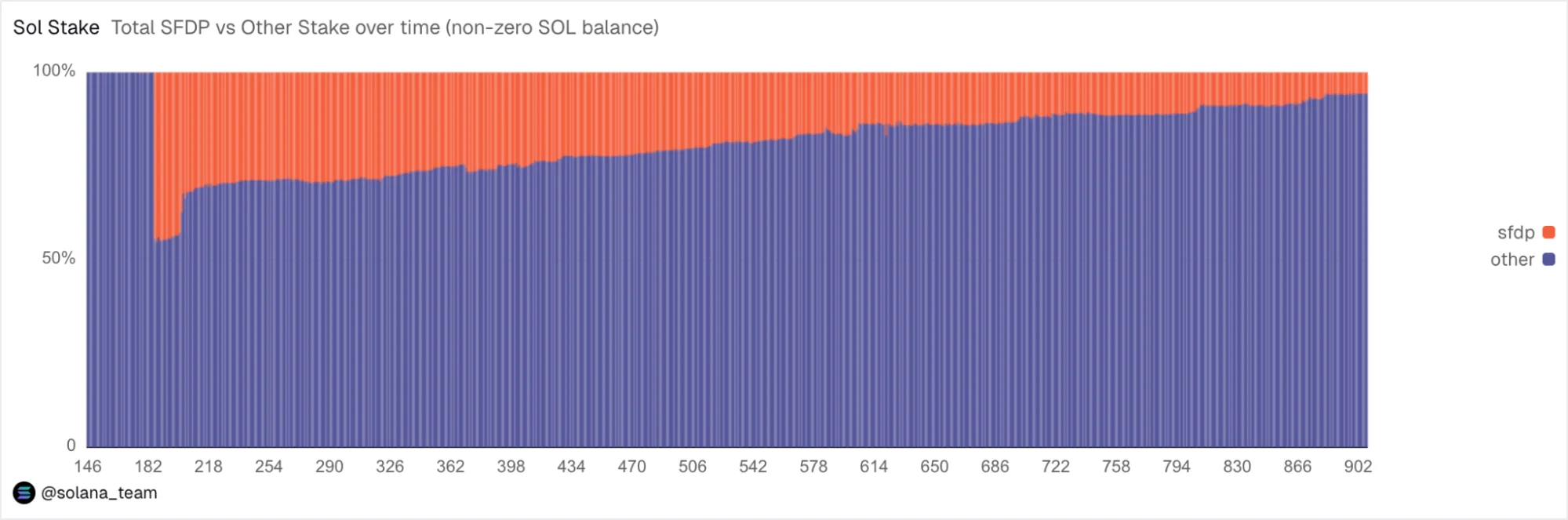
Over time, the SFDP’s share of total network stake has steadily declined. At launch, SFDP delegations accounted for approximately 44.4% of total staked SOL. As of Epoch 881 (November 17 – 19, 2025), that share has fallen to roughly 5.9%.
SFDP Share of Total Stake
Importantly, this decline does not reflect a contraction in the network. Over the same period:
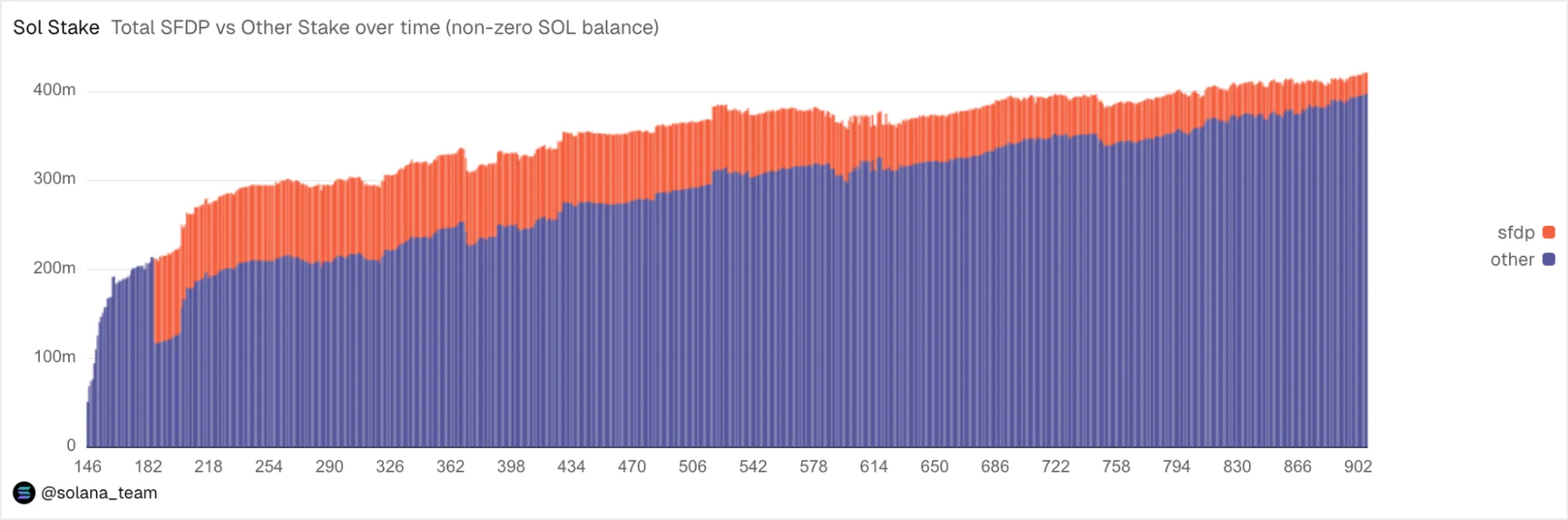 Staked SOL Growth
Overall stake growth reflects both increased network participation and protocol inflation, including an average annual inflation rate of approximately 4.5% since the start. However, the outperformance of non-SFDP stake indicates a clear shift toward market-driven delegation. Third-party delegation increasingly replaced Foundation stake as the primary source of validator support. In effect, the SFDP succeeded in its core objective: economic intervention until the market-driven delegation dynamics could take over.
Phase II: Revised Delegation Strategy (April 2024)
While the SFDP effectively bootstrapped validator participation, a subset of validators remained dependent on Foundation delegation without signs of economic independence.
This dependency posed several concerns:
-
Persistent reliance on Foundation stake without external stake had weaker incentives to compete on performance or differentiation
-
Long-term decentralization would be undermined if Foundation support became a permanent requirement rather than a transitional tool
In response, the Solana Foundation initiated a strategic shift in the program’s design.
On April 24, 2024, the Solana Foundation introduced a revised SFDP delegation strategy, beginning with Epoch 578.
Objectives of the Revised Strategy
The updated approach prioritized validator independence over raw validator count, with three primary goals:
-
Reduce Validator Reliance: Decrease the number of validators fully dependent on the Solana Foundation for stake
-
Incentivize External Stake: Encourage validators to attract non-SFDP stake through matching stake 1:1
Reframing Success Metrics
Under this framework, the Foundation moved away from total validator count as a primary measure of decentralization. Instead, the focus shifted to economic viability without SFDP support.
For analytical purposes, validators holding at least 50,000 SOL excluding SFDP stake are classified as not fully dependent.
Outcomes: Independence Over Quantity
Validator Count vs. Validator Quality
Following the revised strategy, even though the overall number of validators declined, the SFDP continues to support roughly 50% of validators.
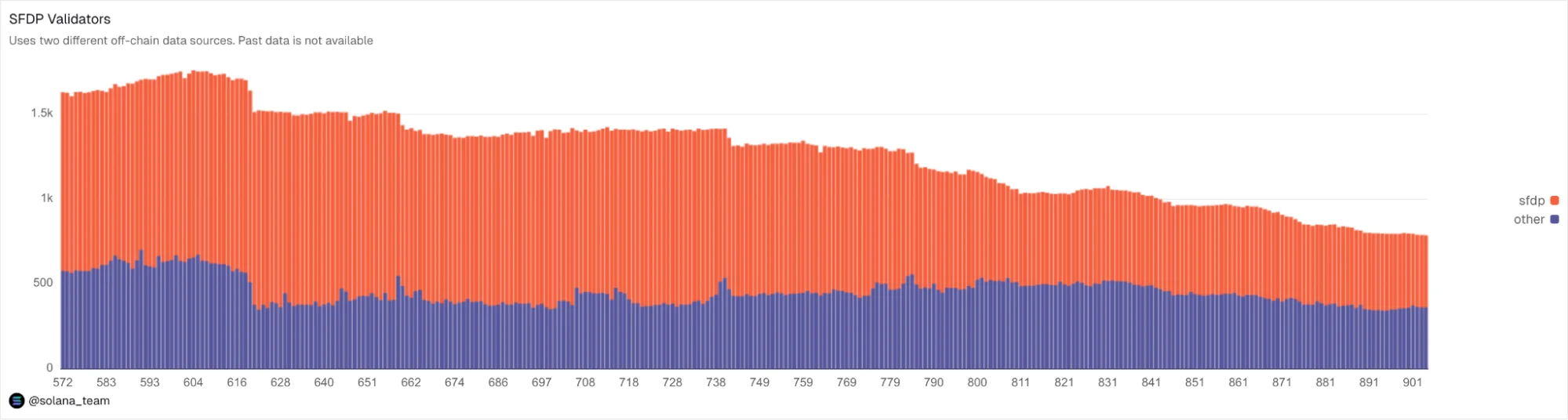 Validators with SFDP Delegation
The number of independent validators (≥50k SOL excluding SFDP) increased by 121% since the launch of the revised SFDP delegation strategy. This shift indicates a validator set that is smaller, but economically stronger and less reliant on Foundation intervention.
Vote Accounts with >50k SOL excluding SFDP
Stability of Stake Distribution
Further analysis of vote accounts exceeding the independence threshold shows that the distribution of stake across validators in the buckets remained relatively stable despite changes in absolute validator numbers. This indicates that network health and stake dispersion was preserved even as SFDP support was reduced.
Distribution of Vote Accounts with >50k SOL excluding SFDP
Phase III: Continued SFDP Matching Reductions (October 2025)
On October 14, 2025, Solana Foundation announced additional changes to SFDP matching to further reduce long-term dependency.
From Epoch 865 to 893:
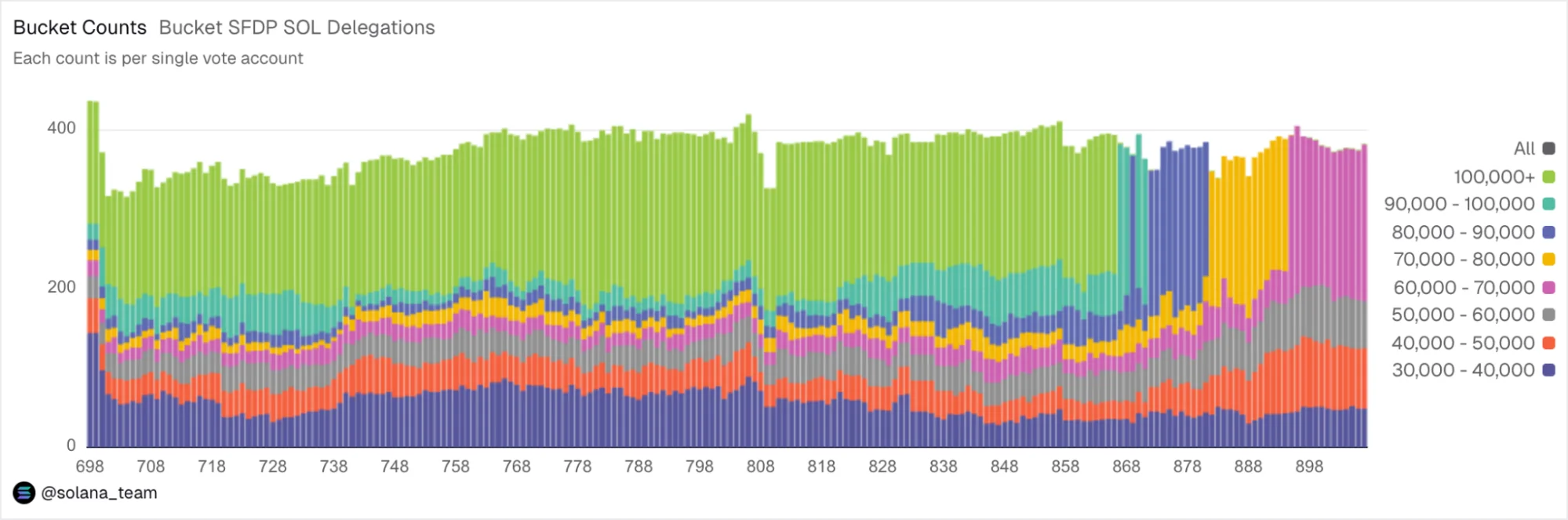 SFDP Delegation Changes
The shift focuses Solana Foundation support on active builders and operators who contribute to network development and operations.
There is increased confidence in the maturity of Solana’s validator economics, including deeper third-party delegation, improved tooling, and more robust fee and MEV dynamics.
Conclusion: Measuring Success by Exit
The Solana Foundation Delegation Program shows how temporary, performance-gated economic support can accelerate decentralization without adding long-term dependency.
In its initial phase, the SFDP succeeded in its primary objective: enabling low-stake validators to reach economic viability, expanding the active validator set, and supporting a more even distribution of stake during Solana’s formative years. Over time, however, persistent reliance on Foundation delegation by a subset of operators emerged as a structural risk, signaling that the program’s role needed to change as the ecosystem matured.
The SFDP’s success is not defined by the amount of stake deployed, nor by maximizing validator count. Instead, it is reflected in the following:
-
A decline in Foundation stake as a share of total network stake
-
Growth in validators capable of operating without SFDP support
-
A deliberate and transparent withdrawal of incentives as the market conditions matured
Despite a 50% reduction in total validators, the number of independent validators (≥50k SOL excluding SFDP stake) has grown by 121% since the launch of the revised SFDP delegation strategy.
By designing the program with clear exit paths and adapting it as the ecosystem evolved, the Solana Foundation shifted from bootstrapping participation to reinforcing independence.
The result is an economically independent validator set that supports decentralization and maintains robust network performance.
Links and Resources
Editors: Ben Hawkins and Tim Garcia
in well organized HTML format with all tags properly closed. Create appropriate headings and subheadings to organize the content. Ensure the rewritten content is approximately 1500 words. Do not include the title and images. please do not add any introductory text in start and any Note in the end explaining about what you have done or how you done it .i am directly publishing the output as article so please only give me rewritten content. At the end of the content, include a “Conclusion” section and a well-formatted “FAQs” section.